awakening-the-leader-within-a-founders

The ability to observe without evaluating is the highest form of intelligence.
— J. Krishnamurti
Table of Contents
Introduction: The Ancient Key to Modern Leadership
1. The Call for a New Leadership Paradigm: Beyond the Lone Hero
2. What is Archetypal Leadership? Accessing the Collective Unconscious
3. The Four Core Energies: An Archetypal Framework for Leaders
The Sovereign: The Energy of Order and Blessing
The Warrior: The Energy of Purposeful Action
The Magician: The Energy of Vision and Transformation
The Lover: The Energy of Connection and Empathy
4. From Archetype to Action: The Conscious Leadership Compass
5. The Archetypal Advantage: Fueling Personal, Team, and Brand Growth
Personal Growth: The Path to Self-Mastery
Team Growth: Building a Thriving Collaboration Ecosystem
Brand Growth: Leading with Humanity and Purpose
6. Your Journey Begins: First Steps in Archetypal Leadership
Conclusion: Leading from a Place of Wholeness
References
Introduction: The Ancient Key to Modern Leadership
As a founder, you’re expected to be a visionary, a strategist, a motivator, and a rock of stability—often all before lunch. The pressure to embody the “lone hero” who can solve every problem is immense. Yet in a world of systemic challenges and radical interconnectedness, this model of leadership is not just outdated; it’s a recipe for burnout and failure. To build something truly transformative and lasting, you need a more profound, more human-centered approach.
The key isn’t a new management fad. It’s a timeless framework buried deep within the human psyche: the archetypes. These are not dusty psychological theories but the very operating system for high-impact leadership. First articulated by psychologist Carl Jung, archetypes are the universal, instinctual patterns of energy that subconsciously drive our motivations, shape our behaviors, and define our leadership styles. They are the source code of our greatest strengths and our most destructive shadows.
This guide is designed to help you decode that operating system. We will explore how archetypal awareness connects directly to the practice of conscious leadership, providing a powerful map for navigating complexity. This is your invitation to move beyond reactive patterns and learn to consciously access a full spectrum of leadership energies—for your own growth, the resilience of your team, and the lasting impact of your brand. Your journey toward a more integrated and powerful form of leadership starts now.
1. The Call for a New Leadership Paradigm: Beyond the Lone Hero
The grand challenges of our time, articulated in frameworks like the United Nations’ Sustainable Development Goals (SDGs), are too vast for any single actor to solve. From climate action to economic equity, progress requires unprecedented collaboration across sectors. This reality demands a strategic shift away from traditional, top-down leadership toward a more conscious and collective approach.
This new paradigm is called Collective Leadership. It reframes leadership not as an individual, hierarchical role, but as the capacity of a group of diverse actors to collaborate effectively in service of the common good. At its core, “collective leadership is the human capacity to dialogue and transform differences into progress.” It is the ability to co-create robust solutions that no single person or institution could achieve alone.
This collective approach is a foundational tenet of conscious leadership, a practice required to transform the dysfunctional systems that create our sustainability challenges in the first place. The ultimate goal is to shift these systems into “thriving systems that add to the richness, diversity, and beauty of all life on Earth.” To achieve this, however, you must first develop profound self-awareness. Archetypes provide the foundational tool for this inner work, offering a map to the internal world that drives your external actions.
2. What is Archetypal Leadership? Accessing the Collective Unconscious
To lead consciously, you must first understand the invisible forces that shape your behavior. Archetypes are the deep, underlying patterns that drive your motivations, reactions, and leadership styles. First described by Carl Jung, they are universal, instinctual patterns common to all human societies, forming a “collective unconscious.” Think of these archetypes as the source code for the human psyche, running in the background of your every decision. Conscious leadership is the art of learning to read and rewrite that code.
Archetypal leadership is the practice of recognizing these powerful energies within yourself and learning how to access them with intention. This is not about putting people into rigid boxes. It’s about understanding that you have access to a full spectrum of archetypal energies—the Sovereign, the Warrior, the Magician, the Lover—each with a vital role to play. However, most of us tend to over-identify with one or two while neglecting others, leading to imbalance. Furthermore, each archetype has a “bipolar shadow”—a dysfunctional expression that emerges when its energy is distorted, suppressed, or over-emphasized.
By becoming aware of these patterns, you can move from being unconsciously driven by them to consciously working with them. This awareness is your key to becoming a more integrated, agile, and effective leader, capable of responding to any situation with the appropriate energy. To make this practical, we begin by exploring the four core archetypes of mature leadership.
3. The Four Core Energies: An Archetypal Framework for Leaders
To understand these potent forces, we can turn to a framework adapted for all leaders from the work of Robert Moore and Douglas Gillette on mature psychology. It outlines four primary archetypes of mature leadership: the Sovereign, the Warrior, the Magician, and the Lover. Each represents a core energy required for balanced and effective leadership. Crucially, each also possesses a bipolar shadow—two dysfunctional expressions that manifest when you over- or under-emphasize that energy, especially under pressure.
The Sovereign: The Energy of Order and Blessing
The first archetype is the Sovereign, also known in classic texts as the King or Queen, representing the energy of order and blessing. In its mature form, the Sovereign provides centeredness, stability, and generative order. This is the part of you that takes initiative for the good of the whole, creating a realm—your company, your team—where others can flourish. The Sovereign’s core functions are to provide blessing, praise, and recognition, fostering a sense of value in others and stewarding a vision for the long-term health of the kingdom.
- Bipolar Shadow: The Sovereign’s shadow manifests as the Tyrant and the Weakling. The Tyrant is the abusive, narcissistic leader who exploits others for personal gain and demands to be the center of the universe. This shadow whispers that your vision is the only one that matters. The Weakling, in contrast, abdicates responsibility. This shadow emerges as paranoia and passivity, allowing chaos to reign while you blame others. Does your fear of failure cause you to retreat into the Weakling shadow when decisive leadership is needed?
The Warrior: The Energy of Purposeful Action
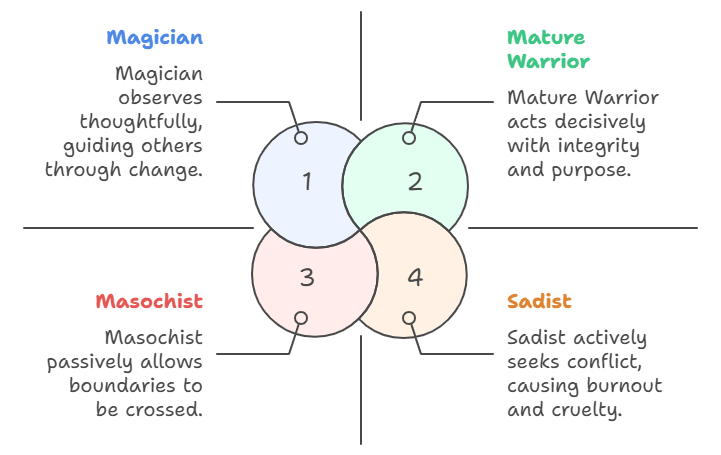
The Warrior is the archetype of purposeful action, clarity, and discipline. This is the energy you access to act with decisiveness, maintain firm boundaries, and challenge disrespectfully with integrity. The mature Warrior is loyal to a mission greater than itself, demonstrating courage, determination, and a willingness to cut through confusion to drive forward. It is the energy of focused, mindful, and purposeful action.
- Bipolar Shadow: The Warrior’s shadow is the Sadist and the Masochist. The Sadist enjoys conflict for its own sake, creating burnout and using cruelty to assert dominance, pursuing victory at any human cost. He is the passionless “killing machine.” The Masochist is the opposite; passive, unable to act, and allowing his boundaries to be crossed. He feels like a victim, unable to endure the necessary pain to achieve his goals. When facing a tough negotiation, does your inner Warrior remain clear and principled, or does it degrade into the destructive anger of the Sadist?
The Magician: The Energy of Vision and Transformation
The Magician is the holder of hidden knowledge, the master of process, and the catalyst for transformation. This energy allows you to maintain perspective through “detached involvement,” observing complex systems and understanding the link between cause and effect. The Magician holds space for different perspectives, creates safety for reflection, and guides others through change. It is the energy of vision, insight, and thoughtful observation that allows for profound transformation.
- Bipolar Shadow: The Magician’s shadow manifests as the Manipulator and the Innocent One. The Manipulator uses secret knowledge and technical expertise for personal gain, creating intrigue and exerting influence through covert means. The Innocent One, on the other hand, is afraid to act. Detached from life and sterile in his thinking, he becomes a voyeur who regrets a life unlived. In your fear of making the wrong decision, do you find yourself paralyzed in the Innocent One’s inaction?
The Lover: The Energy of Connection and Empathy
The Lover is the archetype of connection, empathy, and passion. This is the energy that allows you to feel what others are feeling and to be deeply connected to your people, your work, and the world. The Lover is the source of morale, enthusiasm, and appreciation for beauty. It is the energy that attunes you to the subtle emotional and relational currents within your team, allowing you to sense the underlying unity of all things.
- Bipolar Shadow: The Lover’s shadow is the Addict and the Impotent Lover. The Addict is lost in a world of sensuality, unable to detach or set boundaries, living only for the pleasure of the moment. The Impotent Lover is chronically disconnected, depressed, and anhedonic (unable to feel pleasure). He feels cut off from himself and others, unable to access his feelings or form meaningful connections. When your team is burning out, can you access the Lover to restore connection, or do you retreat into the Magician’s sterile detachment?
Understanding these archetypes and their shadows is the first step toward self-mastery. The next is to apply this knowledge through a practical framework for conscious action.
4. From Archetype to Action: The Conscious Leadership Compass
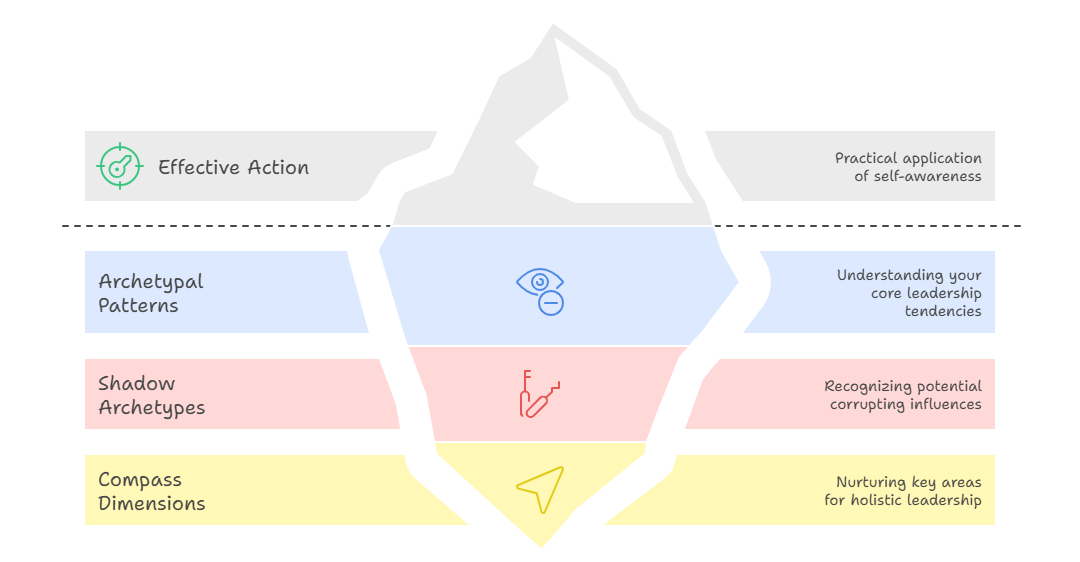
Self-awareness of your archetypal patterns is the essential foundation, but conscious leadership requires a practical tool to translate that awareness into effective action. This is the bridge between understanding who you are and knowing how to act. The Collective Leadership Compass provides just such a framework, offering a navigation system for leading transformative change and cultivating “systems aliveness.”
A conscious leader intentionally nurtures each of the Compass’s six dimensions, drawing on a balanced expression of the four core archetypes. Crucially, they must also remain vigilant for how the shadow archetypes can corrupt each dimension.
Future Possibilities: This dimension is about creating emotionally compelling goals. It requires the Magician’s vision and the Sovereign’s ability to order the future.
Shadow Corruption: A leader in the Manipulator shadow will poison this dimension with a “vision” that serves only their personal gain. The Tyrant shadow will present a future that benefits them at the expense of the realm, breeding cynicism instead of inspiration.
Engagement: This focuses on building collaborative ecosystems with a sense of co-ownership. It is the work of the Sovereign, who unites a realm, and the Lover, who fosters deep connection and trust.
Shadow Corruption: The Weakling Sovereign corrupts engagement by abdicating responsibility and letting the ecosystem descend into chaos. The Addict Lover creates enmeshment and a lack of boundaries, where unhealthy dependencies replace genuine collaboration.
Innovation: This is about fostering creative solutions and new pathways. It calls on the Magician’s hidden knowledge and the Warrior’s drive to challenge the status quo for better outcomes.
Shadow Corruption: The Innocent One shadow paralyzes innovation with a fear of action and risk. The Sadist Warrior corrupts it by pursuing destructive “change” for its own sake, enjoying the fight more than the outcome and burning the team out in the process.
Humanity: This is about cultivating respect, empathy, and balance. It is the direct expression of the Lover’s core energy, which values relationships and ensures people feel seen.
Shadow Corruption: The Impotent Lover poisons this dimension with disconnection, cynicism, and an inability to feel empathy. The Sadist shadow actively destroys it through cruelty, creating a culture of fear and burnout where humanity cannot survive.
Collective Intelligence: This involves using structured dialogue to harvest diverse perspectives. It requires the Magician’s ability to hold differences and the Sovereign’s wisdom to synthesize them for the good of the whole.
Shadow Corruption: The Manipulator destroys collective intelligence by hoarding information and creating intrigue. The Tyrant corrupts it by suppressing dissent and demanding conformity, ensuring that only one voice—their own—is ever heard.
Wholeness: This is the capacity to see the larger system and ensure the collective effort contributes to the common good. It reflects the Sovereign’s role as steward of the realm and the Lover’s sense of universal connection.
Shadow Corruption: A leader in the Tyrant shadow perverts wholeness into serving only the self, sacrificing the system for personal gain. The Addict shadow loses sight of the whole by dissolving into the momentary and sensual, unable to maintain the perspective needed to serve the larger system.
By consciously applying this integrated framework, you can move beyond your default patterns and orchestrate a more holistic and impactful approach to leadership.
5. The Archetypal Advantage: Fueling Personal, Team, and Brand Growth
Why should a busy founder invest time in understanding these concepts? The answer is simple: integrating archetypal awareness into your leadership provides a distinct advantage that translates into measurable growth across every facet of your venture.
Personal Growth: The Path to Self-Mastery
As a founder, this self-awareness is your greatest tool. Understanding your dominant archetypes—and, more importantly, your shadows—is the key to self-mastery. It allows you to ask the hard questions: When I face intense pressure from my board, does my inner Warrior become a decisive leader or a destructive Sadist? What triggers my descent into the Weakling shadow when facing a potential failure? How can I consciously access my Sovereign energy instead? This knowledge helps you identify your triggers, manage your reactive tendencies, and act with intention. It is the work of developing your weaker areas and leading from a place of wholeness, not fragmentation.
Team Growth: Building a Thriving Collaboration Ecosystem
The most resilient and innovative teams are not monolithic; they are dynamic collaboration ecosystems that require a diversity of archetypal energies. To illustrate this, we can use a complementary lens from organizational behavior research that maps functional roles onto these core energies. A conscious leader recognizes the need for balance between:
- The Achiever: The organizational expression of the Warrior’s drive, this energy is focused on victory, tangible results, and overcoming challenges.
- The Guide: Embodying the Lover’s energy in a team context, this role focuses on humanistic growth, coaching, team-building, and morale.
- The Administrator: The functional expression of the Sovereign’s energy, this role maintains order, stability, process, and adherence to rules.
- The Catalyst: Channeling the Magician’s energy, this role inspires transformation, innovation, and a bigger vision beyond the immediate horizon.
A team of only Achievers will burn out. A team of only Catalysts will have great ideas but no execution. By seeing your team through this lens, you can value each member’s unique contribution and consciously build a culture where the whole is far greater than the sum of its parts.
Brand Growth: Leading with Humanity and Purpose
Ultimately, a leader who has integrated the archetypes builds a more authentic and purpose-driven brand. In a world hungry for genuine connection, this humanity-centered approach is a powerful differentiator. A brand led by a conscious founder radiates the best qualities of the mature archetypes: the Sovereign’s commitment to serving the common good, the Warrior’s unwavering integrity, the Magician’s inspiring vision, and the Lover’s deep empathy for customers and employees. This combination fosters profound trust and loyalty, creating a resilient brand that attracts top talent, captivates customers, and earns the respect of all its stakeholders.
6. Your Journey Begins: First Steps in Archetypal Leadership
This exploration is not an intellectual exercise but the beginning of a practical journey. Archetypal leadership is an ongoing practice of reflection and intentional action. Here are a few simple steps you can take to begin applying these concepts today.
- Cultivate Self-Awareness. Take time for reflection. Which of the four core archetypes—Sovereign, Warrior, Magician, Lover—resonates most strongly with you? This is likely your default style. Now, which one do you tend to neglect? Critically, consider how the shadow aspects of your dominant archetype might be appearing in your leadership, especially under stress.
- Practice Invocation. Invocation is a powerful technique for consciously calling upon the energy of a needed archetype. This is not about “acting” or being inauthentic; it’s about centering yourself and calling forth an internal energy that is already present but dormant. Before a difficult conversation where you need to hold your ground, take a moment to invoke the Warrior, feeling its clarity and resolve. To become more connected and empathic with your team, you might read about Eros (the Greek god of love) and pray to him to help you access your Lover energy, feeling more sensual, connected, and attractive in the best sense.
- Observe Team Dynamics. Start observing your team through an archetypal lens. What energies are dominant in your culture? What energies are missing? You may find your team is full of Magician visionaries but lacks the Warrior energy to execute. As a leader, your role is to ask: “How can I create space for different archetypal strengths to emerge and bring our team into greater balance?”
Conclusion: Leading from a Place of Wholeness
Archetypal leadership is not a rigid typology for categorizing yourself and others. It is a dynamic and transformative path toward greater self-awareness, integration, and effectiveness. It is a lifelong practice that connects you to a deep, universal wellspring of energy and wisdom waiting to be accessed within your own psyche.
By consciously engaging with these archetypal forces, you can move beyond fragmented, reactive patterns and begin to lead from a place of wholeness, purpose, and profound impact. This is the shift from merely managing tasks and people to stewarding the aliveness of the systems you are building. For you as a founder, this is the ultimate opportunity: to lead in a way that not only achieves phenomenal success but also creates a lasting legacy and contributes to a more thriving future for all.
References
- Kuenkel, P., Kühn, E., Stucker, D., & Williamson, D. F. (2021). Leading Transformative Change Collectively: A Practitioner Guide to Realizing the SDGs. Routledge.
- Moore, R., & Gillette, D. (1990). King, Warrior, Magician, Lover: Rediscovering the Archetypes of the Mature Masculine. HarperSanFrancisco.
- Ramnarayan, S., & Rao, T. V. (2018). The Archetypal Images of Leadership. Journal of Organisation & Human Behaviour, 7(1).